

Understand your aquarium · 5 min read
Planning a planted aquarium: from idea to planting
A decision sequence for choosing the tank, equipment, hardscape and plants as one coherent project.
Explore the guideSousleau Journal · Updated 2026-09-24
- Starting point
- Water and livestock
- Layout
- Plan mature volumes
- Equipment
- A coherent system
- Success
- A realistic routine
On this page
Write the brief before the shopping list
Describe the intended aquarium in a few sentences: where it will stand, which sides will be visible, intended inhabitants and a manageable maintenance routine. This brief prevents choosing a tank for appearance alone and discovering later that equipment does not fit.
Separate necessities from preferences. Available length, water access and suitable support are practical constraints. Stone colour and branch shape can evolve with the composition.
Three structural decisions
Tank and location
Measure the complete footprint, including hoses, cabinet access and working space. Consider total filled weight.
Equipment level
Decide whether the project uses plants suited to a simple setup or relies on injected CO₂ and closer monitoring. Make this decision before final plant selection.
Maintenance rhythm
Fit trimming, cleaning and water changes into your actual week. A successful layout must remain workable beyond its first photograph.

Build a complete budget
Add support, filtration, lighting, substrate, hardscape and essential accessories to the tank price. If CO₂ is planned, include a compatible cylinder, refills and diffusion equipment. Leave room for consumables and reasonable adjustments.
Compare coherent setups rather than unrelated individual components. A cheap incompatible accessory is not a saving. Record each device’s model, dimensions and connections.
Position hardscape before filling
Try the main masses dry on a protected surface. View the layout from its normal viewing position and any exposed sides. Check stone stability and access around wood. Avoid inappropriate point loads against glass.
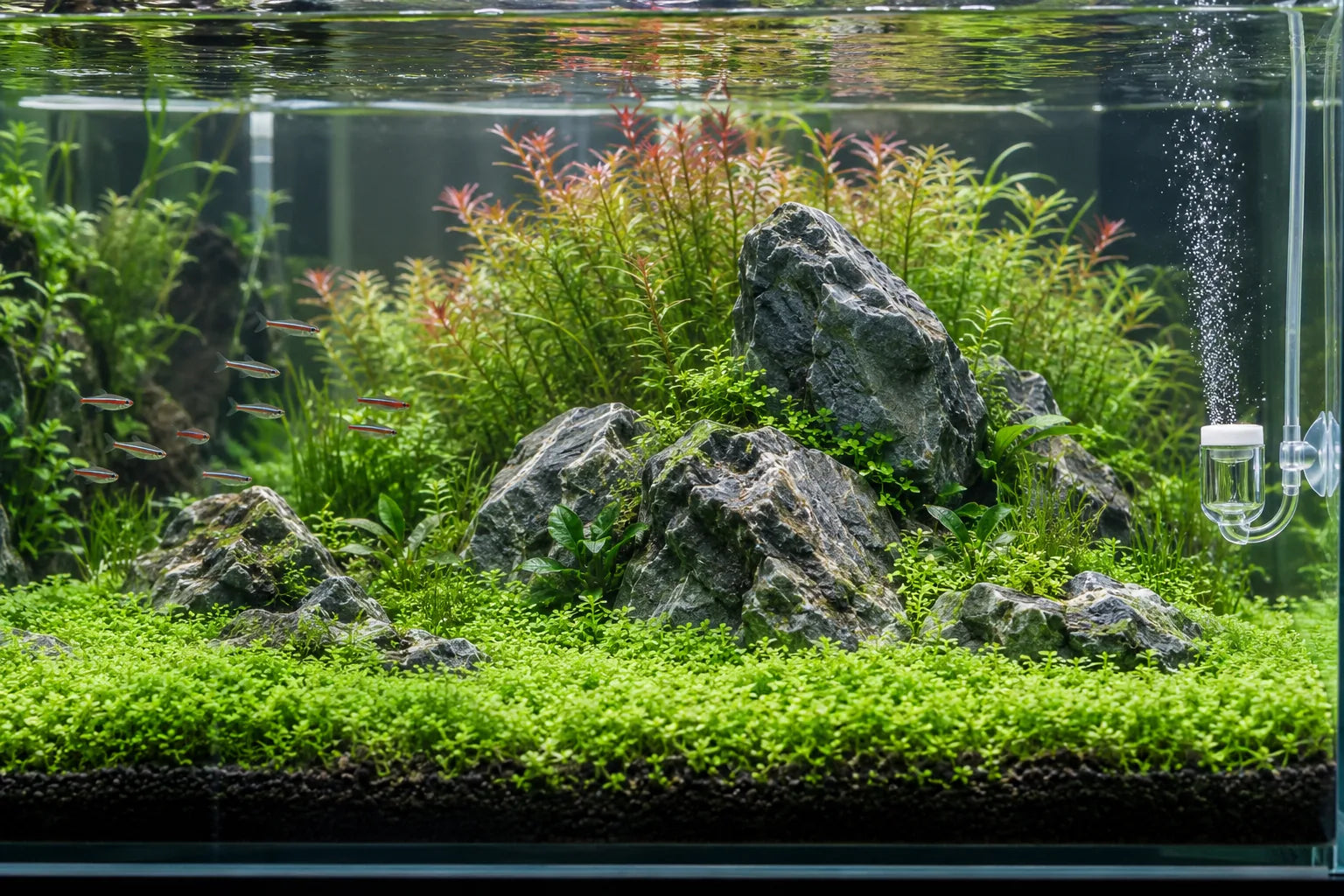
Sketch planting areas next. A mature plant may hide a filter outlet or block access to the glass. Leave room for tweezers and a siphon. The linked composition guide explores visual lines and contrasts.
Organize startup and monitoring
Prepare equipment, plants and water before planting day. Follow tank, filter and equipment instructions. Clear water does not prove biological cycling is established: plan monitoring before adding livestock.
Keep a simple log of dates, measurements, maintenance and photographs. Filling the tank begins a period of development rather than ending the project. Respond to observed problems without changing every setting each time you look at it.

Start with available water and livestock
Before choosing plants, describe the water you will use and the animals you intend to keep. Temperature, hardness and behaviour shape the project. An aquarium for substrate-digging fish requires different planting decisions from one centred on small shrimp.
Avoid creating separate fish, plant and equipment lists and hoping they become compatible when the tank is filled. Choose one coherent direction. If water preparation is needed, include storage, cost and water-change time from the outset. An attractive layout should remain a habitat you can maintain consistently with the resources actually available.
Draw room for mature plants
On a simple sketch, mark the main viewing side, access points and planting zones. Place approximate mature volumes rather than only the small delivered portions. Background stems may hide an intake; a large rosette may close a passage; floating plants may shade a planned carpet.
Leave room for both the eye and maintenance tools. Visual depth also comes from changes in scale, overlaps and open areas, not simply a steep substrate slope. Inspect the layout from your normal viewing position and from above. The second viewpoint often reveals an inaccessible stone or a branch that will prevent glass cleaning later.
Connect light, carbon and maintenance time
Strong light is not an independent goal. It should match the plants, other available resources and the routine you accept. A fast-growing project may require different trimming, monitoring and consistency from a layout dominated by slow plants.
Choose CO₂ for a clear purpose, including accessories and ongoing adjustment. It does not automatically make unsuitable plant choices easy. Likewise, a powerful filter cannot replace a layout that allows circulation. Write down what you can do each week and choose a system matching that availability. Simplicity comes from compatible elements, not just a low equipment count.

Plan stages rather than a completion date
Filling begins an evolving process. Plan stages: equipment installation and checks, planting, establishment observations, biological-function checks, then gradual livestock introduction when conditions allow. A good day-one photograph does not prove readiness for the final population.
Keep a simple log of dates, changes and photographs from the same viewpoint. If an area causes trouble, change one identifiable element and observe. You can replace an oversized species, open a passage or reposition an outlet without treating the project as a failure. A planted aquarium is a living composition; planning its transformation belongs in the original design.
Frequently asked questions
Must I buy all plants at once?
Plan a compatible selection and positions first. Organization matters more than whether an impulse purchase is large or small.
Can I start without CO₂?
Yes, with suitable plants and lighting. Design around that decision.
When can fish be added?
After checking biological readiness and species-appropriate conditions, not water clarity alone.