
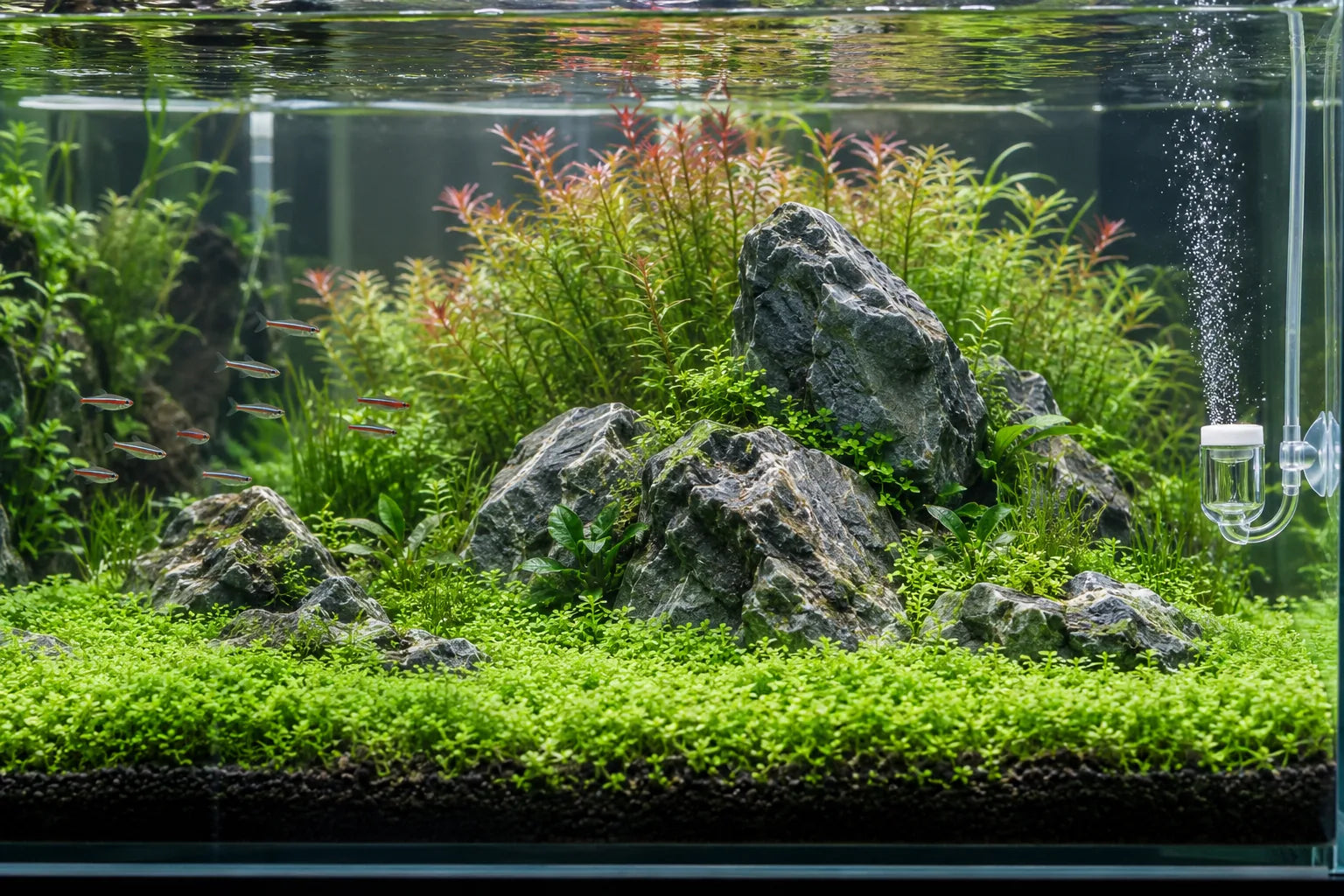

The rhythm of plants · 6 min read
Aquarium plant care: observe, trim and sustain
Regular care for a planted aquarium that develops well. Learn to trim, replant and follow growth without constantly changing the routine.
Build my routine- Observe
- New growth
- Trim
- By growth form
- Measure
- Actual inputs
- Track
- One change at a time
On this page
Good care starts with observation
A planted aquarium is always changing. Stems reach the surface, rosettes occupy more space, and slow growers may barely change for days. Care means working with these different rates while preserving light, circulation and room for future growth.
Choose a few reference points: a stem tip, a young leaf, a plant group viewed from the front and the filter’s flow. Look before touching the tank. A photograph taken from the same position under the same lighting makes comparisons easier.
Do not measure success by the number of interventions. A useful routine avoids both accumulated work and constant changes. First describe what has changed, then decide whether action is needed.
Three rhythms instead of a rigid calendar
Daily · observe
Briefly check the animals, temperature, equipment and loose debris. The goal is to notice change, not to trim a plant every day.
At maintenance · restore order
Group the necessary tasks: thin growth, remove waste, perform the planned water change and check equipment afterwards. Record what you did.
As growth requires · adjust
A group reaching the surface or shading another plant is more useful than an arbitrary date. Match trimming to the aquarium’s actual development.
A maintenance sequence you can repeat
- Photograph first. Keep an overall view before cleaning.
- Prepare. Gather clean tools and replacement water suited to the inhabitants. Follow electrical equipment instructions before working.
- Work on the plants. Remove deteriorating parts and obstructing shoots, then collect fragments.
- Clean accessible areas. Siphon debris without churning roots or lifting a nutrient base layer.
- Change water to suit the tank. Amount and frequency depend on livestock, inputs, measurements and startup stage.
- Check afterwards. Verify the filter, heater, circulation and animal behaviour; record any doses added.
Forgetting to restart equipment can matter more than a leaf left in a corner. Always finish with this operational check.

Trim according to growth form
Identify the plant’s structure before cutting. Upright stems, rosettes and rhizomes need different treatment. Tropica favours moderate, regular trimming over one extensive cut.
| Growth form | Basic approach |
|---|---|
| Stems | Shorten above a node; keep healthy tops for replanting. |
| Rosettes | Remove damaged leaves at their base while protecting the centre. |
| Rhizomes | Remove deteriorating leaves without cutting into the rhizome; divide only sufficiently developed plants. |
| Mosses and carpets | Gradually reduce thickness and collect the fragments. |
Review the shape after a few cuts before continuing. The aim is to give the group room, not to force every plant to the same height.
Replant without rebuilding the whole layout
When a plant group loses its shape, first choose the area to renew. Keep healthy material and identify room for future growth. Working on part of the layout makes the result easier to follow.
Prepare cuttings by removing leaves that would be buried. Space stems so they can be planted properly. Keep the rhizome of Anubias and Java fern exposed; do not bury it merely to hold the plant in place.
If the substrate contains capsules or a nutrient base, uproot carefully. Collect debris and check water and equipment afterwards. Photograph the renewed area to establish a new starting point.
Light and circulation: look at the whole group
A plant can receive plenty of light at the top and very little at its base. Before increasing the light, inspect neighbours, floating plants and surface cover. The problem may be local even when the equipment works correctly.
Assess circulation similarly. Notice debris collecting in the same place, an obstructed intake or reduced outlet flow. Aim for suitable circulation without creating excessive current for the inhabitants.
Keep settings stable enough to compare. If lighting duration, fertilizer and outlet position all change together, it becomes difficult to identify which adjustment helped.
Make fertilization measurable
Record the exact product, millilitres and frequency. Pump counts are useful only when the pump volume is known. Base calculations on actual water volume and the label of the formula in use.
Liquid and root nutrition can complement each other. Account for them together: combining several complete programs does not automatically improve nutrition. After a major trim, reassess demand rather than multiplying supplements.
The Thrive and Elemental guide explains all-in-one formulas and targeted additions. For the tank bottom, see the substrate guide.
Read the signs without guessing a deficiency
An old damaged leaf does not regain its original shape when conditions improve. Look at new growth and how widely the issue occurs. One isolated leaf and several declining species tell different stories.
A newly installed plant may change its foliage during adaptation. That does not automatically explain every decline. Examine planting, the growing point and the tank’s shared conditions.
Describe the issue precisely: old or new leaves, one plant or several, slow or rapid change, and any recent intervention. A photograph documents a sign; it does not always identify the cause.
The plant observation guide can structure the process. If animals also show distress, prioritize water and equipment checks.
Keep a useful care record
A short record is enough: date, overall photograph, dose, water change, trimming and the main observation. Choose a format you will actually use, even after a busy week.
Write the goal before adjusting: “unshade the base of the group” is easier to assess than “improve the plants.” At the next observation, revisit that goal rather than judging the whole tank by one impression.
Allow a stable period suited to plant growth rates. A slow species gives different signals from a vigorous stem plant. If progress is absent, review the history before introducing another change.
Frequently asked questions
Should every plant be trimmed on the same day?
No. Work where it is useful. Spreading the work avoids changing the whole layout at once and makes follow-up easier.
Does a yellow leaf mean iron deficiency?
Not by itself. Look at leaf age, new growth, planting and recent changes before choosing a supplement.
Should I increase lighting to speed recovery?
Not automatically. First check shading and whether other needs are met. A stronger setting does not resolve every cause.
Should I stop all fertilizer as soon as algae appear?
First identify the problem and review the routine. A blanket response can obscure the observations. See the algae guide for further assessment.