
Plant nutrition · 7 min read
Plant nutrition: understanding Thrive and Elemental
A complete formula or a targeted addition? Explore NilocG fertilizers, the role of plant nutrients and a routine that fits your aquarium.
Understand the formulas
- All-in-one
- The Thrive family
- Targeted additions
- The Elemental family
- Measure
- Actual water volume
- Observe
- New growth
On this page
Start with what the aquarium already receives
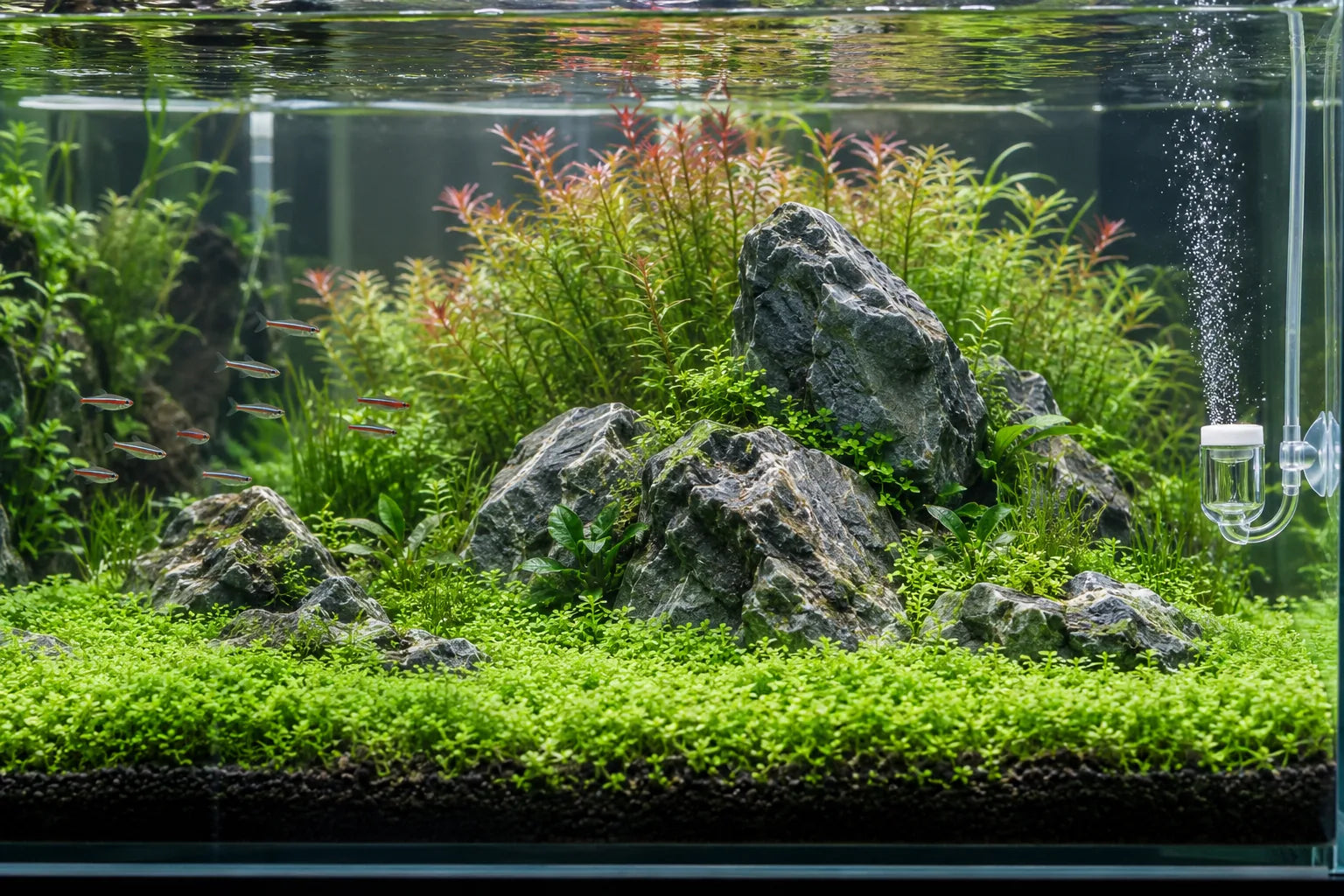
A planted aquarium receives nutrients from several places: its source water, food, decomposing organic material, substrate and fertilizer. The plants’ demand changes as their mass and growth change. A dense tank with injected CO₂ and active stem growth is not the same dosing problem as a lightly planted shrimp aquarium. Before choosing a bottle, list those inputs and describe the growth you actually see.
Fertilizer supplies mineral nutrition. It does not replace light, circulation, appropriate water preparation or a stable carbon supply. Increasing a dose cannot compensate indefinitely for a shaded plant or an unstable setup.
Four Thrive formulas
Start with the plants’ growth rate and the aquarium’s inhabitants. These formulas serve different needs.
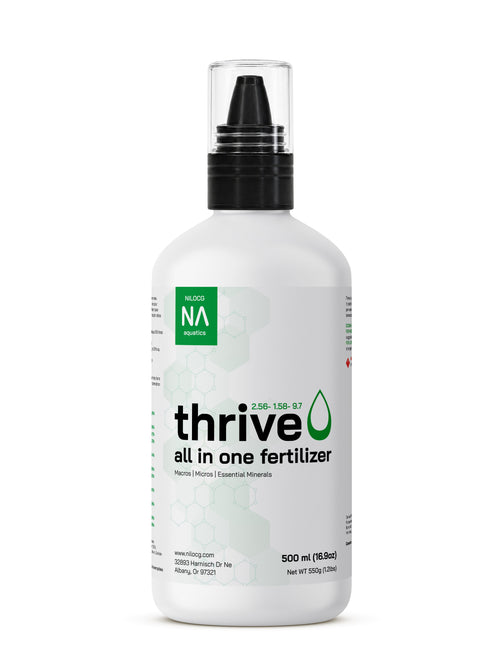
Thrive OG · the starting point
An all-in-one approach to general aquatic plant nutrition. It combines macro and micronutrients in one bottle. Choose it around the aquarium’s needs, then use actual plant growth to guide your routine.
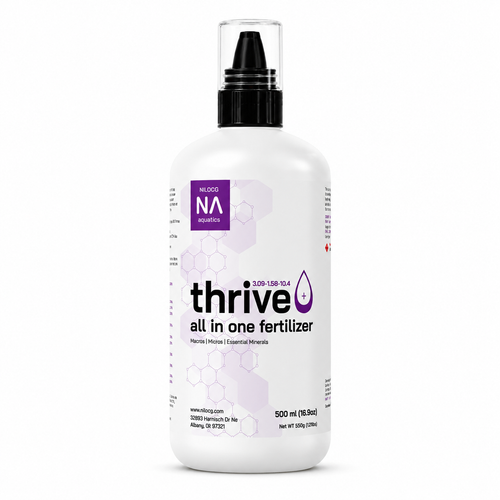
Thrive+ · higher demand
Designed for actively growing planted aquariums, including stronger lighting and injected CO₂. NilocG formulates it for a pH below 7. Check this before choosing: the + does not make it a better fit for every aquarium.
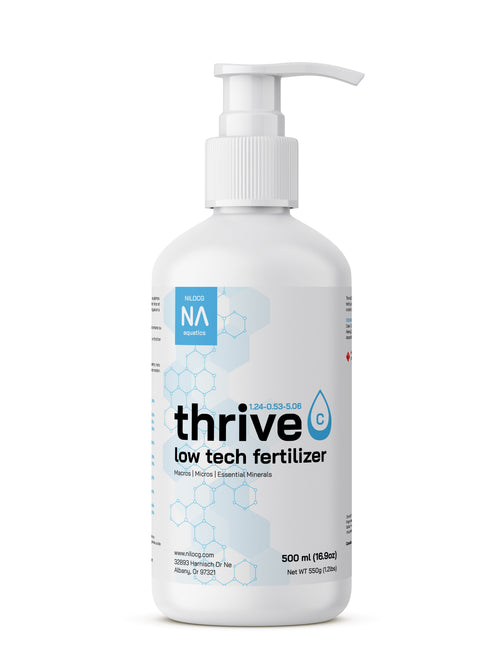
ThriveC · slower growth
Designed for lower-tech aquariums with lower nutrient demand. It offers an approach that fits a slower-growing planting. A liquid fertilizer does not replace the injection of CO₂ gas.
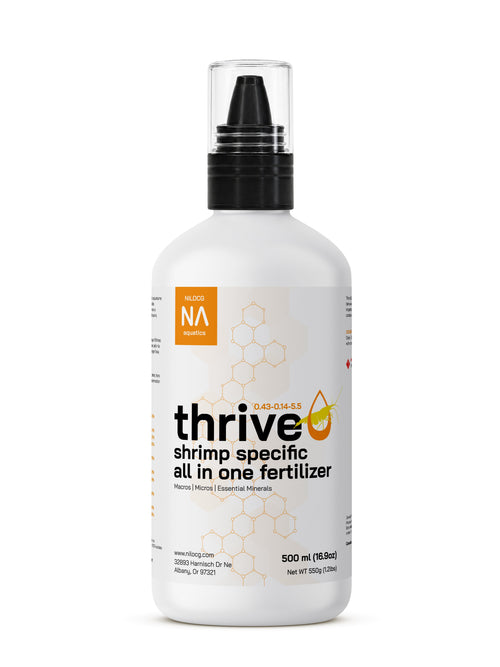
ThriveS · shrimp first
A formula for planted aquariums focused on shrimp, described by the manufacturer as having no added copper. This does not remove the need to measure the dose or meet the animals’ maintenance requirements.
What all-in-one means
An all-in-one combines several plant nutrients in a fixed formula. Each dose raises those nutrients together. This is convenient when you want a repeatable routine with fewer bottles and when the blend suits the aquarium’s overall demand. “Complete” describes the fertilizer’s nutrient approach; it does not mean the bottle also dechlorinates water, sets GH or replaces CO₂ injection.
The useful comparison is the amount added to your actual water volume, not merely the price or colour of the bottle. A concentrated formula may need less liquid, but the correct dose and frequency still depend on its label and your aquarium.
Macro and micronutrients have different roles
- Nitrogen (N) contributes to proteins and other compounds involved in growth.
- Phosphorus (P) participates in energy transfer and cellular structures.
- Potassium (K) supports enzyme activity and internal regulation.
- Iron and other trace elements are needed in smaller quantities for essential plant processes. “Trace” means a small requirement, not an optional one.
A pale leaf or a hole does not identify a missing nutrient with certainty. Leaf age, physical damage, adaptation, shading and water conditions can produce overlapping signs. Use observations alongside the history of your dosing and appropriate measurements.
Also distinguish an analysis expressed as N–P₂O₅–K₂O from a water-test result expressed as nitrate or phosphate. The numbers refer to different chemical quantities and should not be compared directly.
 Elemental Nitrogen ↗
 Elemental Phosphorus ↗
 Elemental Potassium ↗
 Elemental Iron ↗
 Elemental Trace ↗
When targeted Elemental dosing is useful
Elemental separates nitrogen, phosphorus, potassium, iron and trace nutrition into products that can be adjusted individually. This gives you a way to change a particular input without increasing every component of an all-in-one dose. It is useful when you can explain the adjustment you want to make—for example, an established nitrate trend that suggests your existing inputs already cover nitrogen.
Independent bottles also mean more decisions. Write down the concentration, dose and timing of each product. If you combine Elemental with Thrive, include the nutrients already supplied by Thrive in your calculation. Do not automatically add a full separate program on top of a full all-in-one routine. Read the analysis of the trace blend before adding more iron as well.

Liquid nutrition and root nutrition
Liquid fertilizer distributes nutrients through the water. Root tablets or capsules place nutrition in the substrate near rooted plants. They can be complementary, but one is not a universal substitute for the other. A plant attached to wood does not have access to a tablet buried across the tank. A large rooted plant in an inert substrate may benefit from nutrition near its roots.
Follow the specific root product’s placement and replacement instructions. Keep concentrated root fertilizer buried as directed and take care when uprooting plants nearby.
Build a routine you can measure
- Estimate the actual water volume, allowing for substrate and décor.
- Identify every fertilizer and other relevant input already in use.
- Use the matching label to calculate a starting dose; measure small quantities with suitable equipment.
- Keep lighting, water changes and dosing consistent enough to compare observations.
- Photograph new growth and record relevant tests at comparable points in the routine.
- Make one justified adjustment and record its purpose. Reassess before making another.
For arithmetic only: if a hypothetical label specifies 1 mL for 20 L, a 60 L water volume corresponds to 3 mL per labelled dose. This example is not a NilocG dosing instruction and does not establish how often to dose.
Read the label without mixing up units
Start by recording the exact formula, bottle size and amount to dispense. An instruction in millilitres describes the liquid to add; a concentration in mg/L describes an amount of a substance in the water. These are different pieces of information.
An N–P₂O₅–K₂O analysis does not directly report the nitrate and phosphate measured by your water tests. Before comparing numbers, identify the substance, unit and volume involved. Also check whether the instructions describe one addition or the total amount for a week.
Use consistent notebook columns: product, millilitres per addition, number of additions, water-change date and observation. A written routine is easier to review than a series of forgotten pump presses.
Observe the response, then adjust
Choose two or three photographic reference points: a stem tip, a new leaf and a full-tank view. Photograph them under the same lighting. Compare new growth rather than waiting for an old damaged leaf to regain its original appearance.
Record events that affect the comparison: a heavy trim, new plants, a different light or a changed lighting schedule. When several conditions change together, it becomes difficult to attribute an improvement to fertilizer.
Before adding a targeted nutrient, ask a precise question: which input do you want to change, what observation supports that choice, and how will you assess the response? If those answers are missing, first clarify the existing routine.
A week of records may reveal a measuring error; it may not be enough to assess a slow-growing plant. Allow a stable observation period that fits the planting’s growth rate.
Questions that come up often
Will more iron make every plant red?
No. Colour depends on the species and its growing conditions. Extra iron is not a universal colour control and should not be added simply because a plant is green.
Should I stop all fertilizer when algae appear?
First identify the appearance and review light, organic waste, growth and the existing nutrient routine. A blanket reaction can make it harder to distinguish the cause or support healthy plants.
Do shrimp need a different approach?
Choose products appropriate to the inhabitants, respect their labels and include all overlapping inputs. Avoid treating “shrimp-focused” as permission to overdose. Water stability and sensible feeding remain essential.
Where should I start?
Choose the simplest program that matches your aquarium and that you can apply consistently. Explore Thrive formulas for combined nutrition or Elemental nutrients for an adjustment you can identify.