

Caridina multidentata · 7 min read
Amano shrimp: from river to planted aquarium
Origins, natural habitat, diet and aquarium life: discover Caridina multidentata beyond its reputation as an algae eater.
Discover its world- Scientific name
- Caridina multidentata
- Typical adult size
- 4–5 cm
- Feeding
- Omnivore · grazer
- Life cycle
- Freshwater adults · saline-water larvae
On this page
A quiet presence worth watching
A shrimp moves along a branch, pausing between two leaves. Tiny appendages pick, sort and bring nearly invisible particles to its mouth. That continuous movement often reveals an Amano before its transparent body comes into focus.
Caridina multidentata is a translucent grey or beige shrimp with brown dots and short markings. Adults commonly reach roughly 4–5 cm. Females are usually larger, with lateral markings tending towards dashes; these clues are less obvious in juveniles. Its understated appearance lets it belong to the planted landscape without dominating it. [6]
Where was it described, and why “Amano”?
William Stimpson described Caridina multidentata in 1860, with Japan’s Ogasawara, or Bonin, Islands as its type locality. That identifies its scientific reference location, not the first time anyone saw it. In 2006, Cai and colleagues confirmed that the familiar aquarium name Caridina japonica referred to the same species. [1]
Takashi Amano did not discover it scientifically. He helped popularize its role in planted aquariums: ADA’s historical timeline dates his promotion of the shrimp in aquarium magazines to 1983. The common name connects the animal with the development of Nature Aquarium and the idea of building living underwater landscapes. [2]

Its natural habitat: life between stones
In Japan, Amano shrimp inhabit running waters. A study of three rivers in Tokushima Prefecture found a preference for gaps among loose boulders and cobbles; vegetation also offered shelter where those gaps were scarce. A riverbank is a network of refuges as well as a feeding surface. [3]
For an aquarium, take that as a design idea rather than a requirement to copy a river exactly. Provide accessible surfaces, passages and sheltered pockets. A striking but completely exposed arrangement does not offer the same living space as branching wood with small retreats beneath it.

Its aquarium habitat: build a place to live
My starting point would be an established, cycled planted aquarium with room to vary the layout. Suitable volume also depends on other inhabitants and shrimp numbers: a theoretical minimum should not be the design goal.
| What to monitor | Practical approach |
|---|---|
| Temperature | A stable range around 20–25 °C; avoid abrupt changes. |
| pH | About 6.5–7.5 suits many planted setups; account for the source water when acclimating. |
| Minerals | Check GH and KH; do not use pure, unmineralized reverse-osmosis water for keeping shrimp. |
| Water quality | Undetectable ammonia/ammonium and nitrite, regular maintenance and good oxygenation. |
| Safety | Protect filter intakes and close gaps around cables and pipes. |
These are conservative working references, not a reason to alter stable water abruptly. Husbandry guides list wider tolerances; stability still matters when choosing a setup. [4] [5]
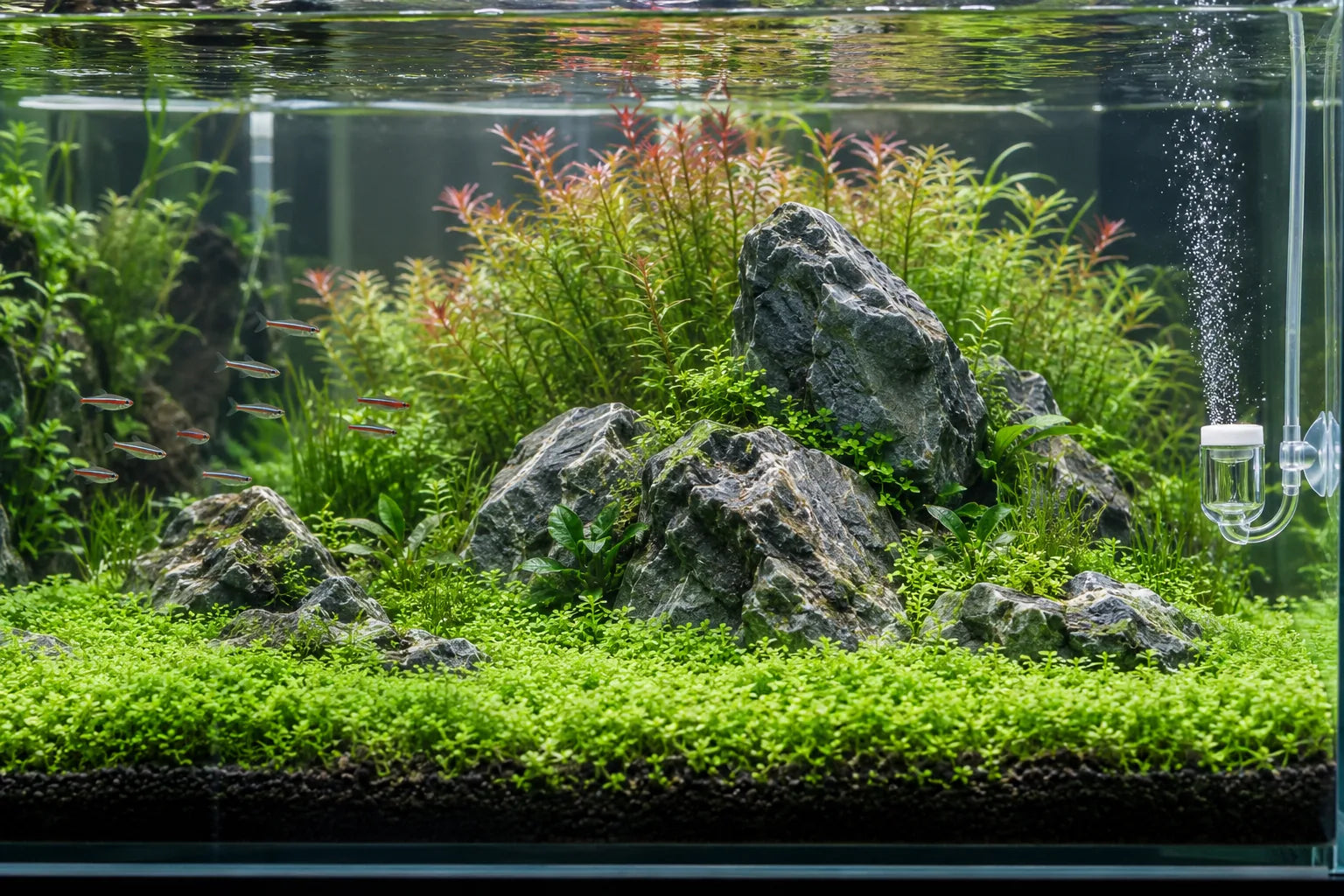
Arrange mosses, ferns or Anubias on wood and stones, keeping an accessible place to watch feeding. Direct the filter outlet so water circulates around the layout without turning every shelter into a strong current. This is a suggested aquascape, not a strict geographical biotope.

Its diet: grazing is only part of the picture
Amanos are opportunistic feeders. They pick at biofilm, accessible algae and organic particles, and also take prepared food. Their constant exploration of leaves should not be mistaken for proof that all nutritional needs are met. [6]
A practical routine starts with a small portion of complete sinking shrimp food and a few minutes of observation. Adjust to the number of animals, available biofilm and food already given to fish. A universal ration for every aquarium would miss those differences.
- Spread it out: try two feeding spots if one animal carries off the whole portion.
- Watch access: make sure quieter individuals also get food.
- Adjust: reduce the next portion if food remains and remove excess before it deteriorates.
- Vary carefully: a small piece of blanched vegetable can supplement the routine, but should not replace a complete diet.
The aim is to feed the animals, not store food in the substrate. Avoiding overfeeding helps protect water quality. [5]
Algae grazing: useful, with limits
Tropica’s comparative trials demonstrate Amanos’ usefulness on certain algae, including filamentous growth, under the conditions tested. They do not establish that shrimp will remove every algae problem in every aquarium. [7]
Before adding more, review lighting, plant development, maintenance and waste accumulation. A shrimp cannot correct unsuitable lighting. Do not starve the animals to make them clean: aim for a lasting balance between the plants, inhabitants and the owner’s routine.
Tank mates, acclimation and moulting
Choose peaceful companions that cannot easily swallow the shrimp. Even an otherwise calm fish may harass a newcomer. Watch actual behaviour around food and shelters. [5]
Before purchase, ask about the holding water’s temperature and parameters. Plan acclimation around the difference and transport conditions rather than a universal timer. Minimize handling and provide quiet retreats on arrival.
Moulting renews the exoskeleton. An empty translucent shell is not necessarily a dead shrimp; hiding afterwards is normal. Avoid dismantling the layout to find a newly moulted animal. [6] Record recurring difficulties and recent changes before reaching for a “moulting” additive.
Reproduction: larvae with a journey to the sea
A female may carry eggs in freshwater without producing a growing aquarium colony. This species is amphidromous: larvae develop in saline water before juveniles return to freshwater. Research shows that temperature and salinity influence development; there is more to successful rearing than a universal salt recipe. [8]
Larval nutrition is a separate challenge. Experiments using phytoplankton and rotifers found effects on survival and development. An adult food pellet cannot recreate that feeding environment. [9] Do not add salt to the community tank because a female is carrying eggs: prepare a separate larval-rearing project.
Observations that deserve attention
If behaviour changes, describe what you see: unusual swimming, gathering near the surface, reduced feeding or several missing animals. Then record recent water changes, new inhabitants, filter maintenance and product use. This sequence is more useful than diagnosing from one behaviour alone.
Check water and equipment before stacking interventions. For fertilizers and treatments, check invertebrate compatibility and the exact dose. Tropica, for example, states that its fertilizers can be used with shrimp; this does not make every product interchangeable or every overdose harmless. [10]
Frequently asked questions
Can they live on the tank’s algae alone?
Do not assume so. Algae quantity and type change; check that the shrimp regularly reach suitable food.
Do they need rare plants or injected CO₂?
No. Easy plants, shelter and stable water can support the project. CO₂ injection serves the planting plan, not a requirement of the shrimp.
Why choose a shrimp with such subtle colours?
For its behaviour: watch it follow a branch, pick through a surface and move between leaves. It brings another scale of life to the landscape.
Sources and further reading
- Cai et al., 2006 — taxonomie et localités / taxonomy and localities
- ADA — histoire de l’aquarium naturel / Nature Aquarium history
- Yonezawa et al., 2023 — microhabitats en rivière / river microhabitats
- Fluval — Caridina multidentata
- OATA — soins des invertébrés / freshwater invertebrate care
- Aquarium Co-Op — observations de maintenance / husbandry observations
- Tropica — essais de brouteurs d’algues / algae-grazer trials
- Kondo et al., 2021 — développement larvaire / larval development
- Hamasaki et al., 2020 — alimentation des larves / larval nutrition
- Tropica — plantes et prévention des algues / plants and algae prevention