
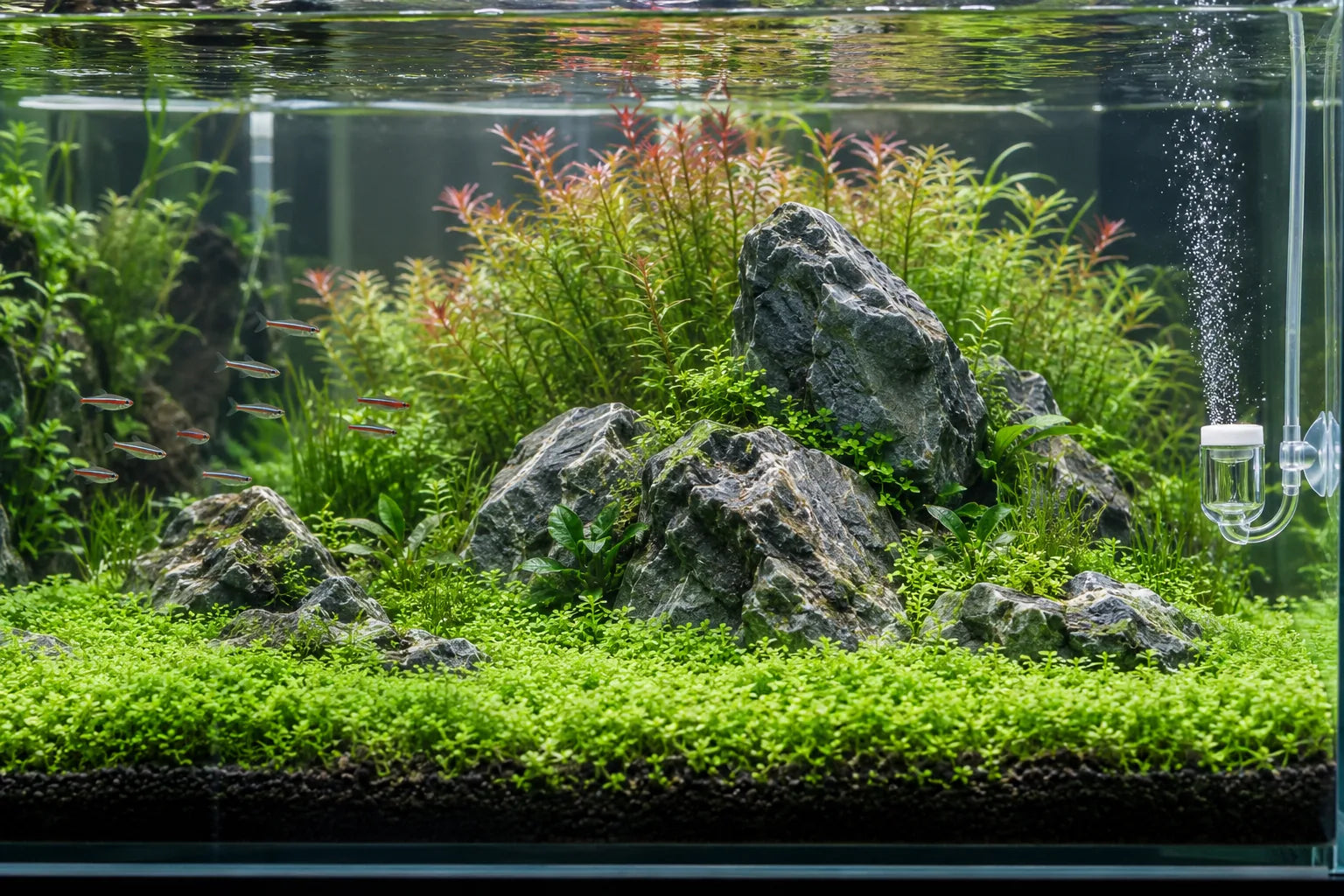

Your first planted aquarium · 11 min read
Easy aquarium plants: grow your first aquascape
Discover eight beginner-friendly plants, learn how to place and plant them, and build a simple routine for your first planted aquarium.
Choose and plant- To help you choose
- 8 plant profiles
- A first selection
- 3 to 5 species
- Initial lighting
- Around 6 hours daily
- Observation log
- The first 4 weeks
On this page
Start with plants that fit your aquarium
A first planted aquarium can look beautiful without intense lighting or a complicated setup. A good start means choosing plants whose size, growth rate and rooting habits suit the tank. An “easy” plant still needs light, nutrients and some attention.
Before shopping, write down the tank’s length and height, substrate, available lighting and water characteristics. Consider its future inhabitants too: fish that dig or nibble leaves influence which plants will work. Plants provide shelter and contribute to the aquarium environment; they do not replace filtration or the care animals need. [9]
For a first layout, we suggest three to five species with different roles. This is a practical design choice: it makes planting, comparisons and maintenance easier to follow. You can add variety once you know how the aquarium grows.

Eight plants to help you choose
These are starting points, not a shopping list to buy in full. Sizes are approximate: lighting, growing conditions and variety can change the final shape. The exact name on the label matters more than a general “easy plant” description.
Anubias barteri var. nana
Its role: compact foliage on a stone or piece of wood near the front or middle.
Originally from Cameroon, this slow grower tolerates a shaded position. It often reaches around ten centimetres in height, with variation. Attach it to the hardscape and leave its rhizome—the thick stem carrying the leaves—exposed. Its slow pace encourages you to watch the quality of new leaves instead of expecting a dramatic change every week. [1]
Java fern — Microsorum pteropus
Its role: add height in the middle without planting into the substrate.
This Asian fern develops elongated leaves, commonly reaching 15–30 cm or more. Grow it on wood or stone with the rhizome uncovered. Allow room around the clump. Small dark spots under its leaves can be natural reproductive structures, rather than disease. Cultivated varieties do not all reach the same size. [2]
Java moss — Taxiphyllum barbieri
Its role: soften a piece of hardscape with fine texture.
This Southeast Asian moss tolerates modest lighting and attaches to different surfaces. Spread small portions and secure them with suitable thread until they take hold. Thick mats are harder to maintain, so keep the layer airy and trim when it spreads too far. It can provide shelter for small inhabitants, but does not replace a habitat suited to their needs. [3]
Cryptocoryne wendtii ‘Green’
Its role: a rooted clump around the base of the hardscape.
This green form of a Sri Lankan species reaches approximately 10–30 cm, depending on conditions. Its leaves can spread outward in an open position. Bury the roots while keeping the crown, where leaves emerge, uncovered. It is a useful midground option; plan for its eventual volume, rather than just the size of the plant you buy. [4]
Limnophila sessiliflora
Its role: an airy background with readily visible growth.
These Asian stems carry finely divided leaves in whorls. They can approach 40 cm and need regular trimming. Plant a group of separate stems. If long gaps develop between the leaves, check the light actually reaching them. Easy to grow does not necessarily mean little pruning: choose this plant if you enjoy trimming and replanting. [5]
Bacopa caroliniana
Its role: calmer vertical structure with oval leaves.
This North American species works well in small stem groups. It often grows to around 20–30 cm, at a relatively leisurely pace for a stem plant. Space the stems apart and leave access for trimming. Cut shoots can renew the group, making this a useful way to learn propagation without adding more species. [6]
Vallisneria spiralis ‘Tiger’
Its role: a curtain of ribbon-shaped leaves at the back.
Leaves can reach 30–50 cm. This striped selection produces runners that gradually expand the group. Give it an area where that spread can be managed, and keep the crown above the substrate. In a shallow, small tank, its long leaves may occupy more space than expected: check the available dimensions before choosing it. [7]
Sagittaria subulata
Its role: a small meadow of rosettes linked by runners.
Space individual plants apart to give them room. Size is the main caveat: this species may stay fairly low or become much taller, reaching around 50 cm in some conditions. It suits a flexible layout and does not guarantee a short lawn. If you want a consistently open foreground, give it a dedicated area to one side. [8]
Plan the layout before filling your cart
Imagine the tank from the place where you will most often view it. A tall group behind a piece of wood, a few clumps at its base and an open foreground can be enough to create depth. Repeating one species in two places can make a clearer composition than introducing a different plant into every gap.
Ask three questions about each plant: where will it be in six months, how will I maintain it, and will it shade its neighbours? Leave room for your hand, glass cleaning and access to the filter. A layout that is easy to maintain has a better chance of staying enjoyable.
Choose your pace as well. Slow growers keep their shape for longer, while a stem group will need more trimming. Combining them gives you a stable framework and an area where you can learn to follow new growth.
Pots, cups and substrate: prepare what you buy
A potted plant generally has an established root system. Remove the container and gently free the roots from their growing material, following the supplier’s instructions. One portion may contain several plants to separate. Avoid pulling on the leaves to extract them.
A tissue-culture plant is sold young in a cup with growing medium. It does not provide the same immediate volume as a large potted plant. Prepare portions according to the range’s instructions and remove the gel before planting. Compare the number of planting points, portion size and maturity, rather than just the price of the container. [15]
The substrate anchors plants and, depending on its composition, may also feed them. Inert gravel and a nutrient-rich soil do not provide the same things. Some substrates alter water chemistry and require a particular startup routine. Follow their instructions, including rinsing and water changes. Plants attached to hardscape can grow without nutrient-rich soil beneath their roots; their nutritional needs still have to be met. [9] [12]

Plant according to the growth form
Prepare the hardscape and tools before unpacking the plants. In a new tank, working with a few centimetres of water over the substrate makes placement easier. Keep the foliage moist throughout the process. [10]
- Rhizome plants: attach Anubias and Java fern to a surface. Keep the rhizome exposed to the water; roots can extend down towards the substrate.
- Rosettes and runner plants: bury the roots and leave the point where leaves emerge uncovered. A plant that floats up needs repositioning, not a deeply buried crown.
- Stem plants: remove transport ties and plant individual stems, without crushing their bases or burying a tightly packed bunch.
- Mosses: spread small portions over the surface and attach them lightly. Avoid a thick, compressed bundle.
Fill gently so you do not dislodge the plants. Take a starting photograph: it will help separate actual growth from day-to-day impressions.
Light, CO₂ and nutrients: a consistent routine
Duration does not replace intensity. A weak lamp left on for a very long time does not become suitable lighting. Around six hours a day on a timer is a reasonable initial reference suggested by Tropica. Adjust gradually according to growth and algae; there is no need to extend the lighting period automatically. [11]
CO₂ injection is not essential for every project. Several undemanding plants let you begin without a pressurized system. Accept a growth rate and appearance suited to that choice. A CO₂ system adds settings and monitoring; a cylinder alone cannot fix poor planting. [12]
Fertilization depends on what the aquarium needs. Plants require several elements, including nitrogen, phosphorus, potassium and trace elements. Water, substrate and other inputs all contribute. Read a fertilizer’s composition and dose for the actual water volume. An all-in-one formula simplifies dosing, while a targeted supplement addresses a specific need. Avoid stacking several formulas without checking what they contain. [12]
The first month: observe before changing everything
The following table is our suggested observation log, not a promise that an aquarium matures in thirty days. Renewed plant growth and readiness for animals are separate questions: biological cycling and water parameters need their own checks. [9]
| When | What to observe | What to record or do |
|---|---|---|
| Planting day | Planting depth, attachment, circulation | Photograph the tank; note species, lighting and substrate. |
| First week | Damaged leaves, dislodged plants, equipment | Remove debris; follow substrate instructions and water test results. |
| Second week | New shoots and areas remaining in shade | Compare a photograph from the same angle; avoid moving every plant. |
| Weeks three and four | Overgrown stems, new leaves, returning algae | Trim lightly if needed; adjust one parameter at a time. |
Water-change needs depend partly on the substrate and stage of startup; one schedule does not suit every tank. Keep a record of interventions. This makes a request for advice much more useful than an isolated photograph accompanied by “nothing is growing.”
Understand the most common setbacks
Leaves melt after purchase. Some plants, especially Cryptocoryne, may lose leaves while adapting to new conditions. Remove decomposing material, but do not automatically discard a base that remains firm. Look for new leaves. Continued decline or a softened crown calls for a closer check of conditions; not every failing plant is simply adapting. [14]
A plant seems to stand still. Judge it against its own growth pattern. An Anubias is not a Limnophila. Check new growth, attachment and the light actually reaching it before changing three products at once.
The tank fills too quickly. Trim stems in small sessions and thin groups that spread too far. Replanting a few healthy shoots helps renew a group. Avoid removing all the vegetation at once. [13]
Algae appear. Record their form, position and any recent changes. Continue with our aquarium algae guide. A pale or damaged leaf alone cannot conclusively identify a particular nutrient deficiency either.

A first layout with room to develop
Here is a starting idea for a rectangular aquarium about 60 cm long, adapted to its height and inhabitants. It uses four species; the eight profiles above help you choose alternatives.
- On the wood: a few Anubias nana plants for a compact focal point.
- In the middle: one Java fern with room for its mature leaves.
- At the base: a small group of Cryptocoryne wendtii ‘Green’.
- In one rear corner: a group of Limnophila sessiliflora that is easy to reach for trimming.
Keep part of the foreground open. How much to buy depends on the actual size of pots and cups and the area you want to plant. Sketch the groups before counting portions. This is a planting composition, not a recreation of one specific natural biotope.
Your first goal can be straightforward: plants that are securely placed, healthy new leaves and a routine you want to keep. Density and detail can develop with time.
Frequently asked questions
Can I succeed without CO₂ injection?
Yes, with suitable plants and realistic expectations. Start with reasonable lighting, correct planting and consistent nutrition. Growth may be more modest. Avoid choosing a demanding carpeting plant solely to reproduce a photograph.
Do I have to use an active aquarium soil?
No. The choice depends on the plants and the water conditions you want. Epiphytes attached to hardscape do not need an active soil to anchor themselves. Rooted plants need a suitable growing medium and sufficient nutrition, whether supplied through the substrate, root supplements or the water.
How long before the aquarium looks full?
There is no guaranteed timetable. Initial portion size, species and conditions all matter. Compare photographs week by week and look for signs of establishment. Dense foliage alone does not prove that the tank is ready for animals.
Sources and further reading
Original Sousleau text. The cultivation references below provide guidance, without promising identical results in every aquarium. Consulted in September 2026.
- Tropica — Anubias barteri var. nana.
- Tropica — Microsorum pteropus.
- Tropica — Taxiphyllum barbieri.
- Tropica — Cryptocoryne wendtii ‘Green’.
- Tropica — Limnophila sessiliflora.
- Tropica — Bacopa caroliniana.
- Tropica — Vallisneria spiralis ‘Tiger’.
- Tropica — Sagittaria subulata.
- OATA — How to set up a planted aquarium.
- Tropica — Planting by growth form.
- Tropica — Growing-in.
- Tropica — Fertiliser and CO₂.
- Tropica — Trimming.
- Aquarium Co-Op — Planting and acclimating Cryptocoryne.
- Tropica — Preparing tissue-culture plants.